The Florália Iron Ore Project
High-grade DSO hematite in the heart of Brazil's Iron Quadrangle. Near-surface, free-dig, friable direct-shipping hematite with multiple domestic buyers within 34 to 47 km by road. Hematite sample grades of 55-61% Fe.1,3 No mineral resource has been defined.
Overview
The Florália Iron Ore Project is a high-grade hematite Direct Shipping Ore (DSO) project located in Minas Gerais, Brazil's Iron Quadrangle - the country's most established and mining-friendly iron ore district. The Property covers approximately 613 hectares, 70 km east of Belo Horizonte, surrounded by world-leading iron ore producers including Vale and ArcelorMittal.
Under the definitive option agreement dated May 12, 2026 (announced May 13, 2026), the Company may acquire a 100% interest in the Florália Property from Max Iron Brazil Ltd. (a subsidiary of Max Resource Corp., TSXV: MAX) through staged share consideration over 30 months.4
Project Highlights
Florália upgrades a large in-situ deposit to a premium 61% Fe product by simple dry magnetic separation: no wet plant, no tailings dam, and buyers within short-haul trucking distance.
Geology
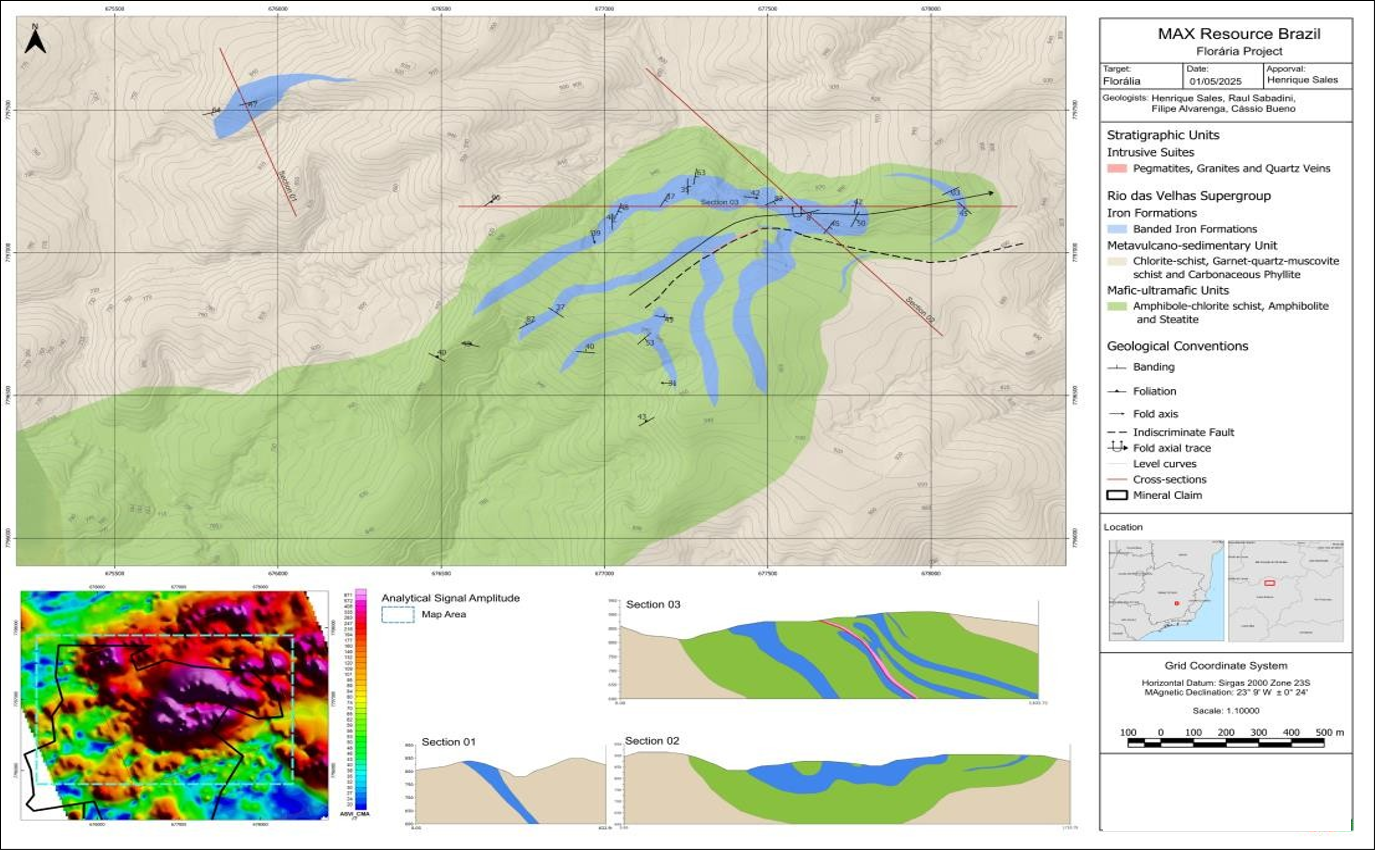
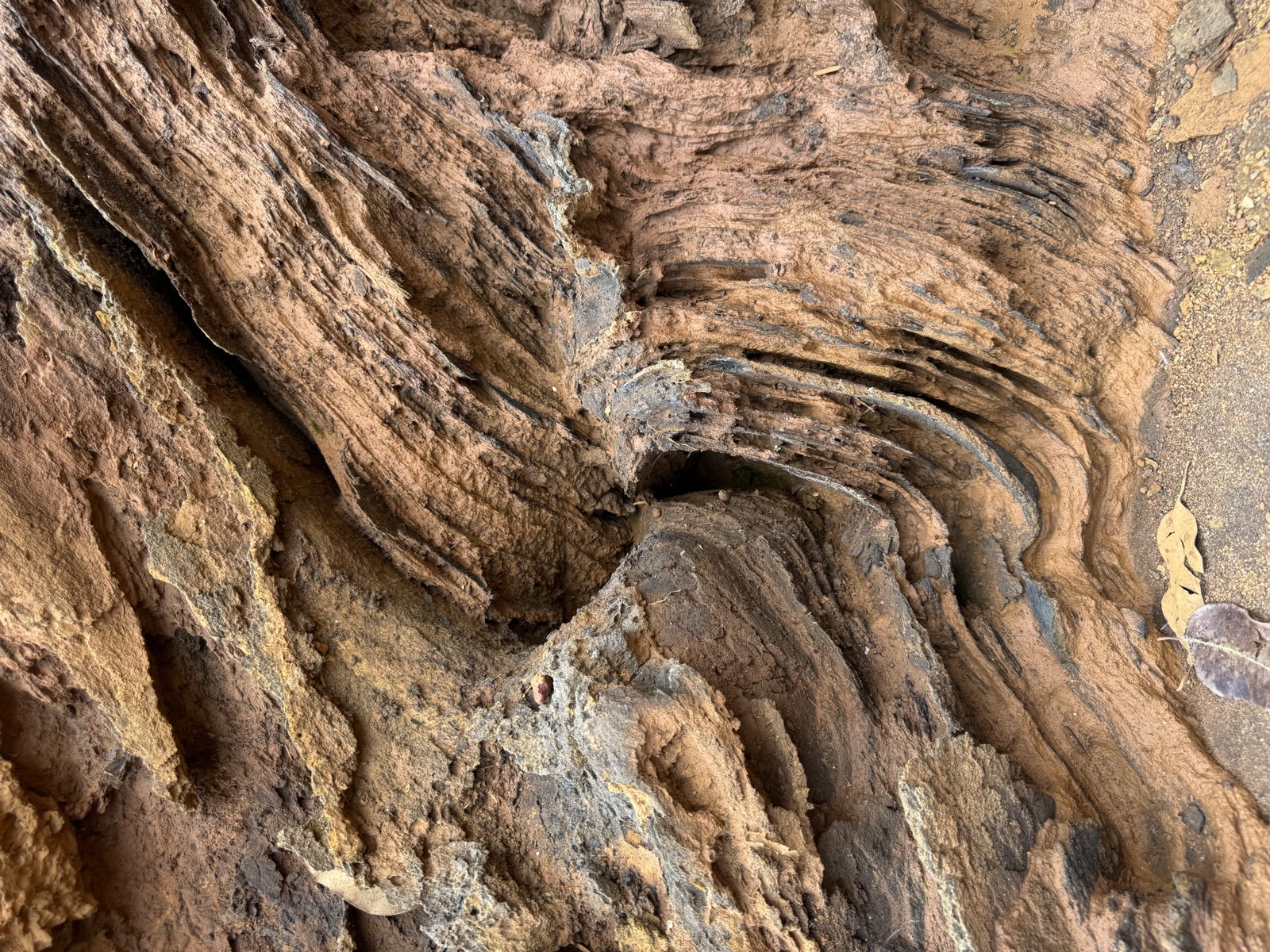
The Florália deposit consists of banded iron formation (BIF) lenses hosted within Archean metamorphic rocks of the Quadrilátero Ferrífero (Iron Quadrangle) geological province - the same regional setting that hosts Vale's Brucutu, ArcelorMittal Andrade, and several other operating DSO mines.
Detailed geological mapping conducted at 618 observation points across the entire claim area has defined the BIF lens geometry, allowing the geological team to constrain the high-grade hematite zones and design subsequent drilling.
Exploration Work Completed (2024-2025)
- Geophysics: 225 km drone airborne LiDAR and magnetic survey; identified mineralized zones and structural controls.
- Geological mapping: 618 observation points; detailed BIF lens definition across the claim area.
- Channel sampling: 186 channel samples (Jaguar and Max); 68% returned grades above 50% Fe, with low phosphorus (0.01-0.05%).
- Diamond drilling: 6 holes totaling 761 metres; intersected 222 metres of oxidized iron formation.
- Auger drilling: 86 holes (890 metres total); 274 samples analyzed by SGS Geosol.
- Geometallurgical testing: Six 80 kg bulk samples; concentrates of 54-69% Fe depending on feed grade.2,5
Metallurgy
Geometallurgical bench-scale testing was conducted on six bulk samples representing coarse fractions (2 mm, 6 mm, and 12 mm) across three magnetic field strengths (1,400, 2,500, and 7,500 Gauss) to evaluate dry magnetic concentration of the material.
Dry magnetic separation upgraded blended composites of ~47-52% Fe feed to 62-68% Fe concentrate, an increase of 8 to 17 percentage points.2,5 Mass recovery and product grade trade off directly: on the tested material a 61% Fe product corresponds to approximately 60% mass recovery (the planning case), a 57-58% Fe product to approximately 71%, and feed of 56% Fe and above returned 77-80% mass recovery at 61-69% Fe. The best pilot fractions reached 69% Fe. Mass recovery is not iron recovery. Grades by portable XRF are indicative only and certified assays are pending; testwork is not a mineral resource estimate.
The process is 100% dry: free-dig mining, crush and screen, dry magnetic separation, then biomass drying to ~3% moisture. No water permit is required and no tailings dam is needed; rejects are dry stacked.5
From Deposit to Product
130-170 Mt itabirite Exploration Target.1
50-70 Mt friable hematite DSO; grade control required to sustain feed in this range (Exploration Target1).
30-42 Mt of product at ~60% mass recovery by dry magnetic separation.1,5
Best pilot fractions approached premium sinter-feed quality.3
Product Quality
| Specification | Florália product6 | IODEX 61% baseline6 |
|---|---|---|
| Iron (Fe) | 61.0% | 61.0% |
| Silica (SiO2) | 3.0% | 4.5% |
| Alumina (Al2O3) | 1.3% | 2.5% |
| Phosphorus (P) | 0.04% | 0.10% |
| Moisture (H2O) | 3% | 8% |
At benchmark on grade and below it on every penalty element: a value-in-use credit for nearby mills, not a discount. Product specification is subject to confirmation by certified assay.6
The Company's conceptual processing approach is dry processing, which is intended to reduce reliance on wet beneficiation. Permitting requirements are subject to regulatory review and have not been finalized. Tailings and water management are relevant considerations in Brazil following the 2019 Brumadinho dam disaster.
Strategic Location
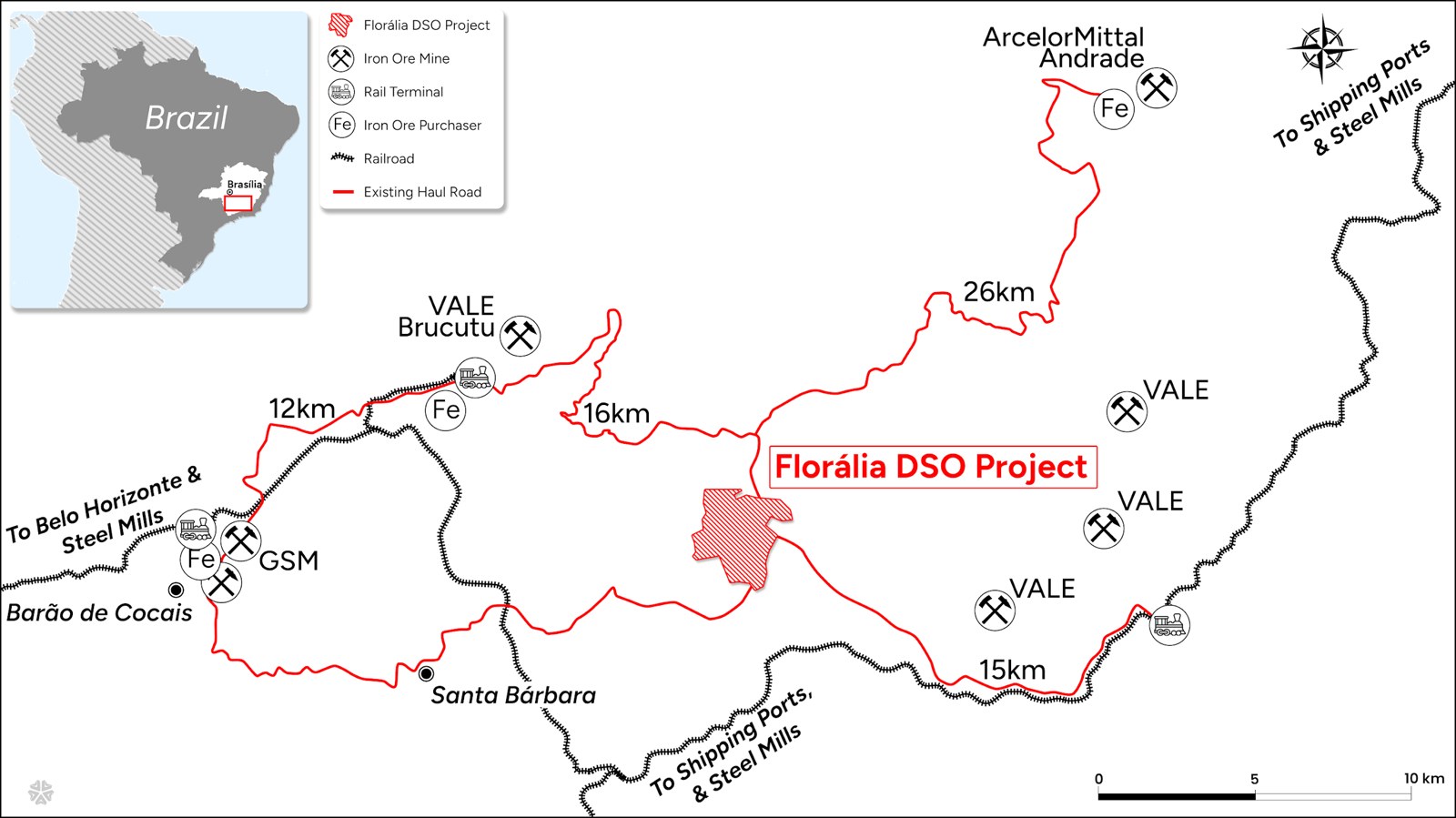
Florália sits within the Iron Quadrangle, 70 km east of Belo Horizonte, surrounded by producing mines and steel mills. Multiple buyers sit within 34 to 47 km by road:
One of the world's largest producers
Local miner and historical buyer
Major domestic steelmaker
Route to Market
Minas Gerais holds the largest concentration of steel mills in Brazil and the country's independent pig iron sector, buying granular iron ore at Florália's grade today: 9 of Brazil's 31 steel mills, 43 merchant pig iron plants producing ~75% of national pig iron, and a granular ore band of 55-64% Fe that Florália's 61% product sits inside.8 Usiminas, Gerdau, ArcelorMittal, Aperam and Vallourec all operate mills in the state.
- Independent domestic mills: local pig iron and steel buyers collect at or near the mine gate; a premium for low-alumina feed and no export logistics. The primary margin driver.
- Regional spot buyers: an active local miner and historical buyer takes spot tonnes when short on premium blending material. Tactical upside.
- A single large-volume buyer: volume certainty on a term basis. The volume floor.
- Seaborne export: sold via a trading counterparty who handles rail, port and ocean freight. The benchmark floor.
Domestic sales capture most of the benchmark, while export remains an option, not a necessity. No offtake agreement is in place and no counterparty is committed.
Development Scenario (Conceptual)
Conceptual initial capital of approximately US$12 million to production, prepared by the Company and not supported by a feasibility study:7
| Plant installation and acquisition | ~US$6.0M |
| Earthworks and site preparation | +US$2.0M |
| Lab, equipment and machinery | +US$2.0M |
| Working capital | +US$2.0M |
| Total capital to production | ~US$12M |
Phase I contemplates a 1.5 Mtpa run-of-mine operation with domestic trucking and a single processing line; 1.5 Mtpa is a regulatory cap, not a ceiling. Phase II is a conceptual expansion to up to 4.5 Mtpa with two additional modular lines and a third-party logistics provider handling rail and export. Phase II is optionality, not a committed plan: it is conditional on resource expansion to support the larger rate, full EIA/RIMA permitting for 4.5 Mtpa, long-term biomass supply contracts and self-funding from Phase I cash flow, and it is not a basis for current valuation.
Permitting and Environmental
- EIA/RIMA: State environmental licensing in progress with SEMAD (Minas Gerais); the key path item to a construction decision.
- Surface rights: The CENIBRA surface indemnity (Acordo de Servidão) is being finalized to secure site intervention rights.
- Processing approach: The Company's conceptual approach is dry processing.
- Permitting: Requirements are subject to regulatory review and have not been finalized.
- Mining state: Minas Gerais, an established Brazilian mining jurisdiction.
Next Steps
The Company is planning technical and economic studies on the Florália DSO project as exploration advances. Any feasibility-level study is contingent on first defining a mineral resource. A feasibility study and a construction decision are targeted for 2027, with first production targeted for the second half of 2027. These targets depend on exploration results, study outcomes, permitting, and financing. Current activities include:
- Drilling: the current drill programme is ongoing, designed to support a maiden NI 43-101 mineral resource estimate.
- Feasibility study: targeted for 2027, with a construction decision also targeted for 2027. No mineral resource has been defined on the Florália Property to date.
- Surface rights: finalizing the CENIBRA surface indemnity (Acordo de Servidão).
- Environmental licensing: filing with SEMAD (Minas Gerais) to trigger the construction countdown.
- Detailed engineering (EPCM): moving the plant from conceptual design to executable blueprints and securing vendor fabrication slots.
- Construction and first production: a three to six month modular build following the licence, with first production targeted for the second half of 2027. No production decision has been made.
- Refining the Leapfrog 3D geological model and continuing exploration to assess the resource potential of the Property.
Notes and References
- Cunha, E. (2024). Exploration target report for the Florália ferrous mineral deposit (Project: Floralia Ferrous Mineral Deposit, Iron Quadrangle, Minas Gerais State, Brazil). MAX Resource Corp. Prepared by Competent Person E. Cunha, MSc, AusIMM #230572, under the 2012 JORC Code.
- Dry magnetic testwork on Florália samples by Fundação Gorceix (project 25.050 variability study and preliminary study, December 2024) and Inbras (March 2025).
- Max Resource Corp., "Max Resource Reports High-Grade Iron Ore (Fe) Results from Florália Hematite DSO Project in Minas Gerais, Brazil," news release dated April 22, 2025.
- 26 Metals Inc. (as Bolt Metals Corp.), "Bolt Metals Executes Option to Acquire the High-Grade Florália Iron Project," news release dated May 13, 2026.
- DMT Group, "Projeto Florália, Max Resource: Estudo conceitual de Beneficiamento," April 2026 (internal conceptual beneficiation study), together with the testwork in note 2. Mass recovery is not iron recovery. Grades by portable XRF are indicative only and certified granulochemical assays are pending. Testwork is not a mineral resource estimate.
- Product specification per Cunha, E., "Independent Geologist Report: Florália Project," EMC2 Geological Services and Mineral Consultancy Ltd, January 2025; subject to confirmation by certified assay. Benchmark: S&P Global Platts IODEX 61% Fe iron ore fines (CFR China); baseline 61% Fe, 4.5% SiO2, 2.5% Al2O3, 0.10% P. Platts reset the benchmark from 62% to 61% Fe in January 2026.
- Conceptual initial capital of approximately US$12 million, prepared by the Company. Conceptual estimate only; not supported by a feasibility study, and no mineral resource has been classified for Florália. The Phase I rate of 1.5 Mtpa is a regulatory cap on run-of-mine tonnage, not a production forecast.
- Instituto Aço Brasil (Brazil Steel Institute), Steel Park; Sindicato da Indústria do Ferro no Estado de Minas Gerais (SINDIFER).